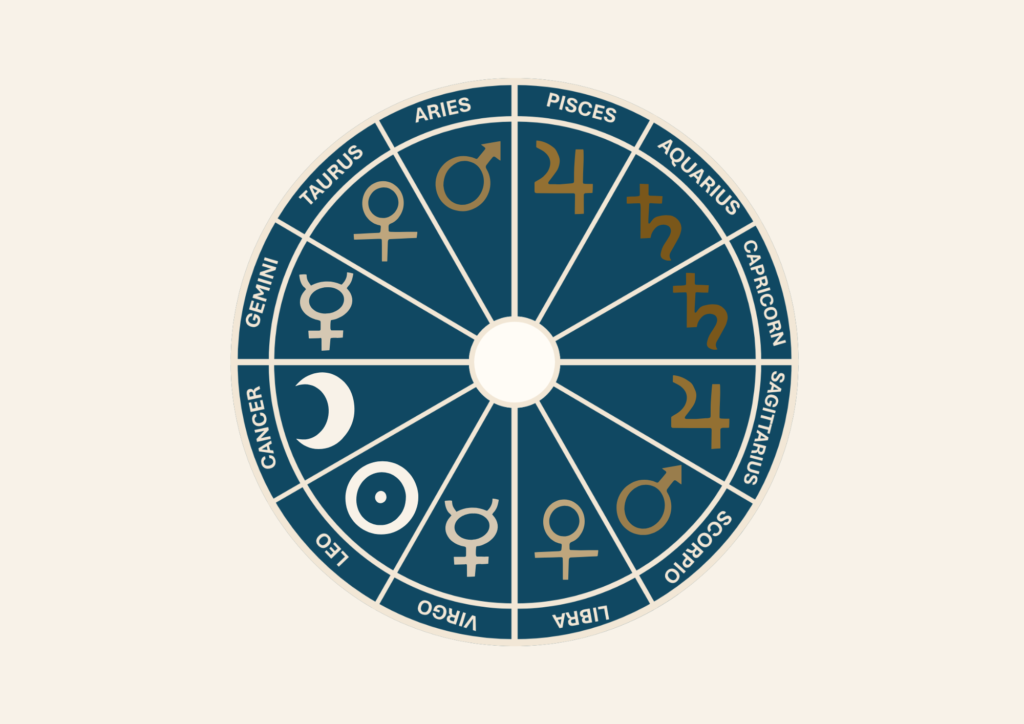
The Thema Mundi
Each planet has at least one home sign. There it can best unfold its topics and themes, because the sign’s qualities match the planet’s nature.
The THEMA MUNDI is a traditional model that depicts which sign is the home of which planet and the story goes something like this:
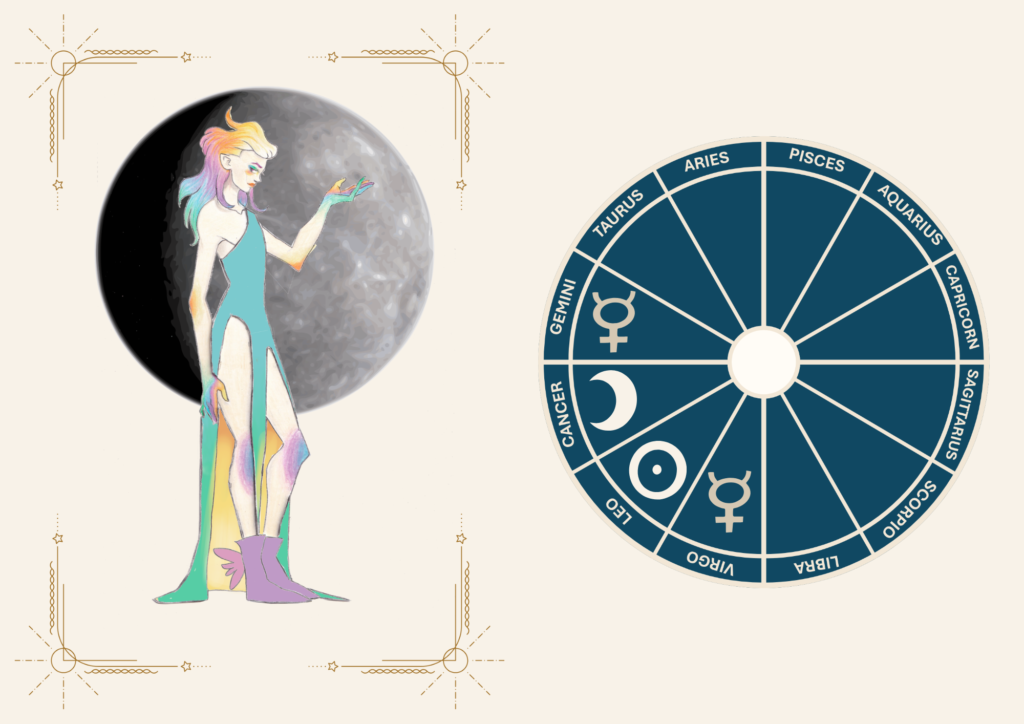
The Sun and the Moon, the king and queen of heaven, ruled the sky from their constellations, Leo and Cancer. Mercury saw this and thought that some land would be nice to store the information he gathered on his travels and to organize them for their utility.
So he devised a ploy.
Humbly, he went to the Sun and asked for some land and the Sun in grand generosity gifted him the sign next to his, which was Virgo. Clever, as Mercury always is, he went to the Moon the next day to bring her the latest news. Amidst all this he remarked on the Sun’s present and the queen, who was naturally giving, granted Mercury the sign next to hers, which was Gemini.
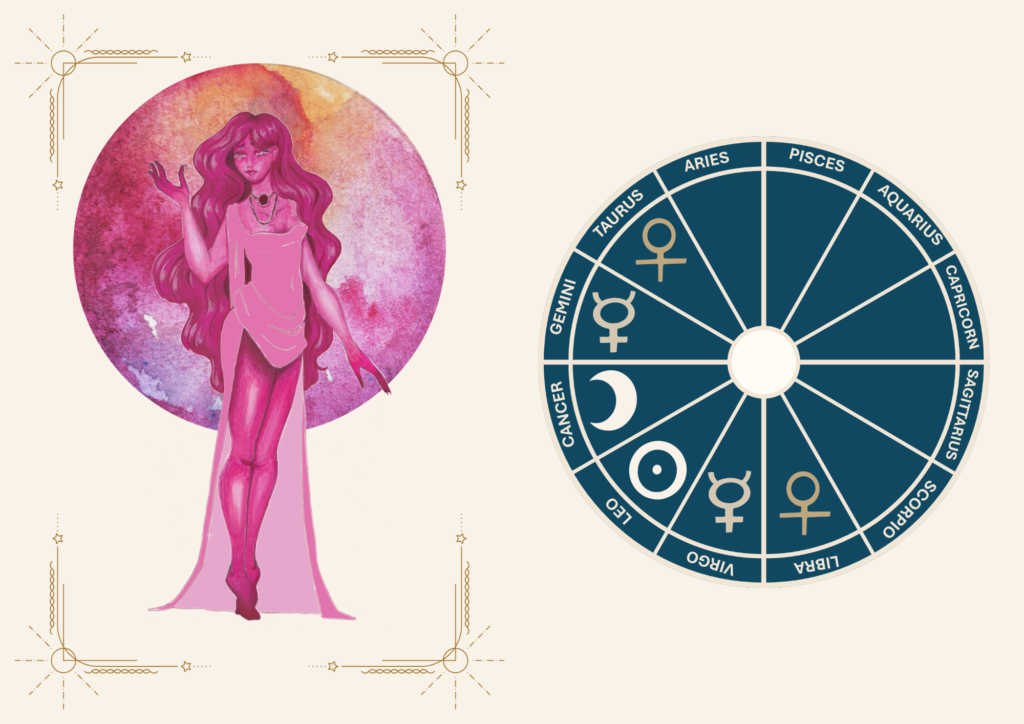
Seeing the beautiful shimmer of Mercury’s constellations, Venus desired a home of her own and, batting her eyes and sweea-talking the King of Heaven, received the sign of Libra in return. But Mercury had two signs, and naturally Venus wanted a second constellation as well. She went to the Moon who she could not beguile with her charm. Instead, Venus promised to apply her sense of beauty to the land she hoped to gain, and thus received Taurus.
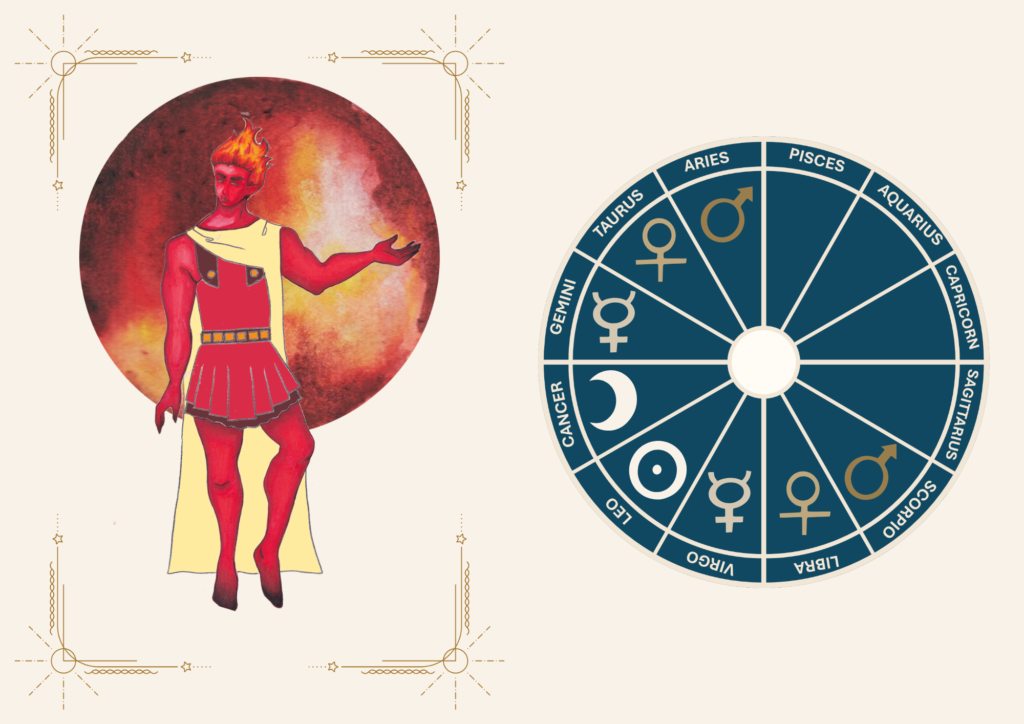
Mars, feeling slighted, for he had not received any land despite his effort, went to the Sun in cold rage to take it all for himself, and with the blade pressed against his throat the Sun offered the sign of Scorpio, knowing that Mars would withstand the dangers of this land. Thereafter, Mars went to the Moon, his anger had not dissipated, but flared and he threatened to destroy her home, should she not grant him another constellation. And he recieved Aries in turn.
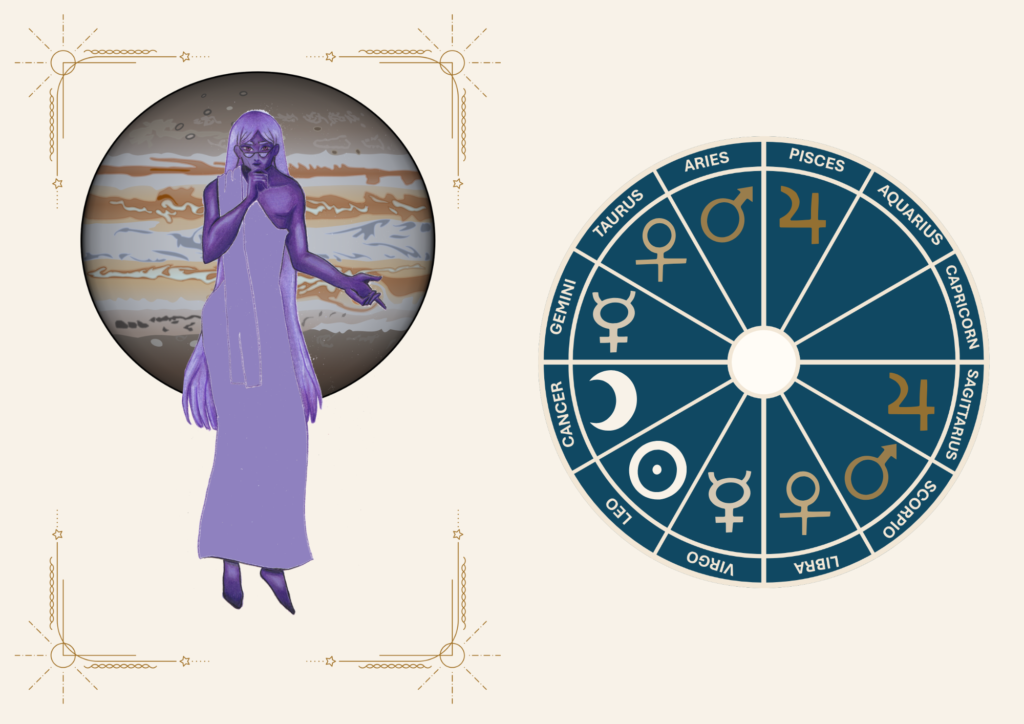
Next, Jupiter, the Sun’s advisor, who travelled the sky far and wide, went up to the king. On his many travels he had found much meaning, but one constellation in particular offered him the expansion he sought, so he asked whether he could call it his own. Thus he received the sign of Sagittarius. To the Moon he went too, who had always enjoyed Jupiter’s counsel and when he asked ownerhsip over the wonderous land of Pisces, the Moon granted him his wish.
Last came Saturn, the stern architect and rulemaker of heaven, and although he had built the constellations for the Sun , the king had but one more sign to offer, which was Capricorn. Seeing that yet one plot of land was uninhabited, Saturn went to the Moon. He promised her a utopia, quite different from the traditional Capricorn, and so the Moon granted him the sign of Aquarius.
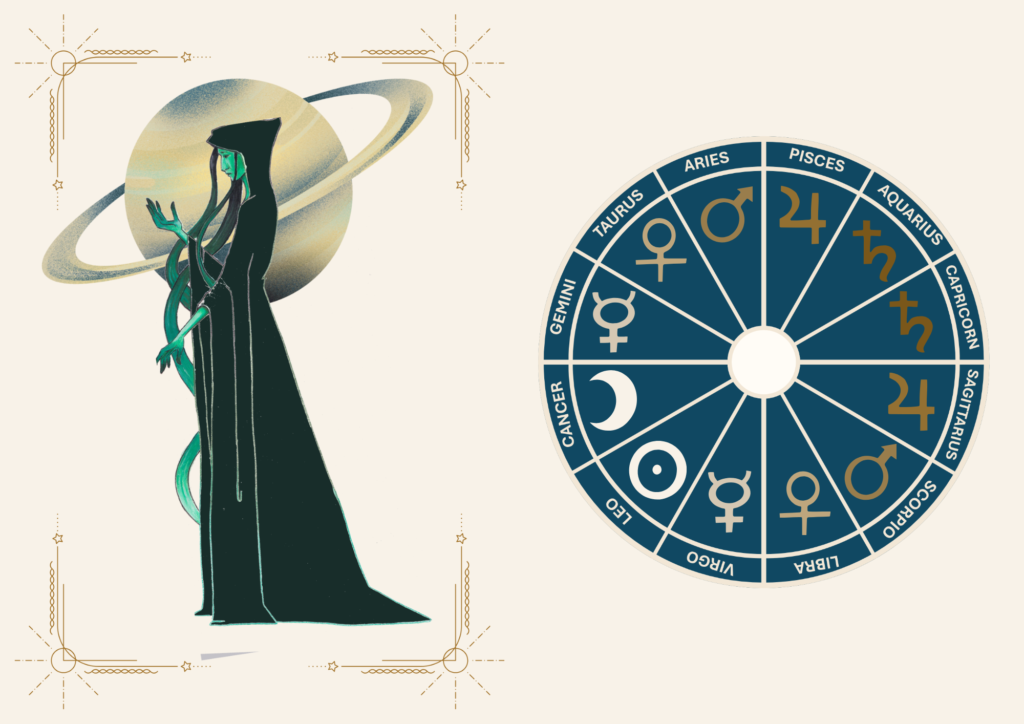
This has been a creative retelling of the Thema Mundi incorporating the qualities of the planets as well as the zodiac signs. There is however rhyme and reason to the arrangment. The luminaries are paired together, and the other planets are arranged by speed, with Mercury being the fastest and Saturn the slowest planet, as well as distance from the Sun, with Mercury being the closest and Saturn the farthest.
As stated at the beginning, the Thema Mundi depicts the traditional rulership in which the signs are the homes of the planets. This arrange-ment isn’t random, it has a nice symmetry to it and shows the symbolic relationship of the planets.
The luminaries, the Sun and the Moon, who are able to emit and receive light, have their homes next to each other in the signs of Leo and Cancer. At the opposite end of them are Capricorn and Aquarius, the homes of Saturn, who is assoicated with darkness.
Venus, which is the planet of desire and pleasure, has its home signs, Taurus and Libra, opposite to Scorpio and Aries, which are the domicile of Mars, itself associated with conflict and strife. Venus brings things togehter and Mars tears them apart.
Finally, Mercury’s and Jupiter’s signs are placed at opposite ends, Gemini opposes Sagittarius and Virgo opposes Pisces, because one is focused on the details and the other on the big picture. Mercury is focused on reason while Jupiter is focused on expansion.