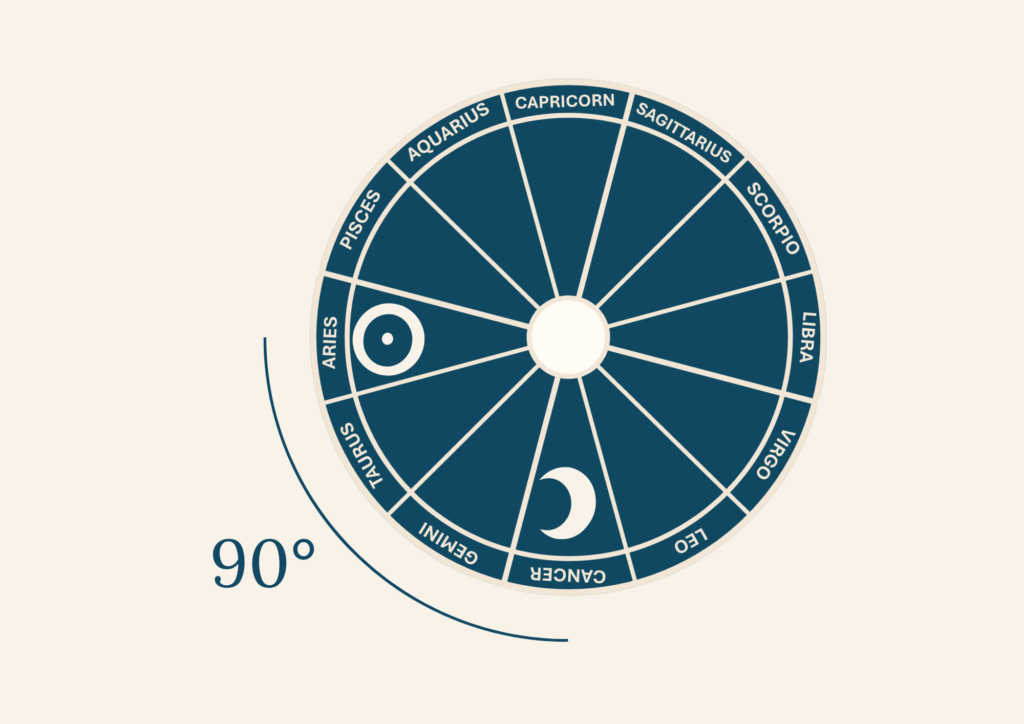
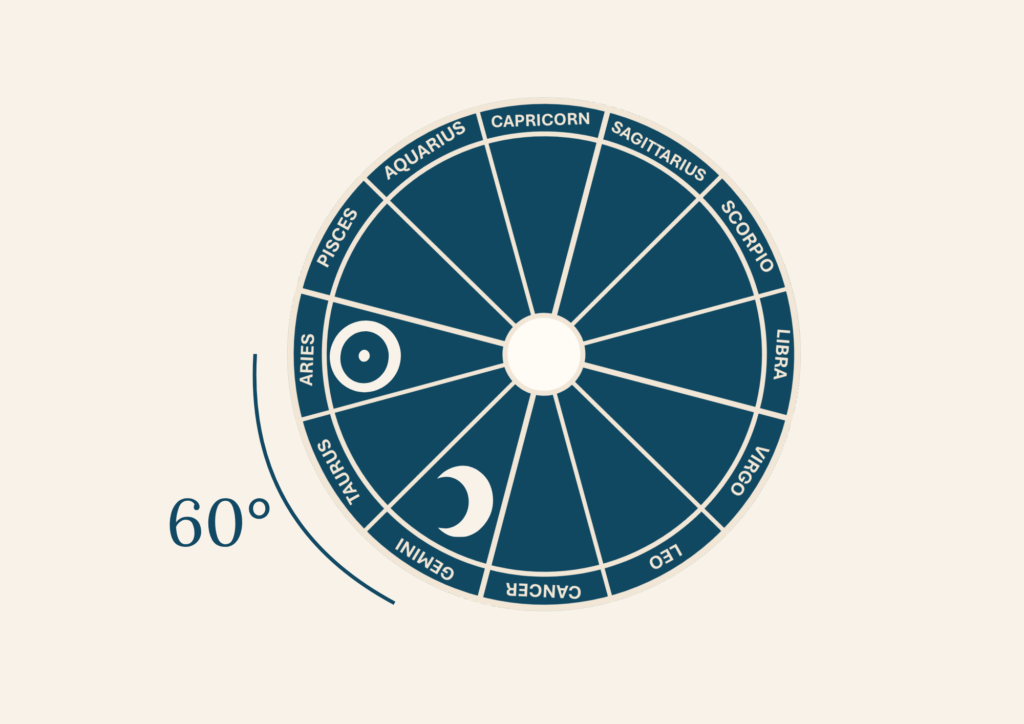
Aspects show the relationship between two planets, whether they are in a harmonious friendship or regard each other as enemies. They can be viewed in two different ways. Sign-based aspects are derived from the arrangement of the zodiac signs, while degree-based aspects are connected to the division of the 360° zodiac circle.
Sign-Based Aspect
Sign-based aspects show the relationship between two planets based on the arangement of the signs within the zodiac wheel as organized by the signs’ polarities, modalities, and elements.
This aspect is fixed by sign. A planet in Aries is always in a sign-based trine to a planet in Leo no matter if both planets are at 15° of the involved signs or one is at 1° Aries and the other at 29° Leo.
The field of influence of these aspects lies always within the bounds of the involved zodiac signs. A planet in Aries would never be in a sign-based trine with a planet in Virgo.
Degree-Based Aspect
Degree-based aspects show the relationship between two planets based on the divsion of the 360° zodiac circle. While each aspect has a distance at which the aspect becomes exact, orbs allow a field of influence. Has a planet reached this orb, the aspect comes into effect.
This aspect isn’t fixed by sign. A planet at 1° Aries wouldn’t be in a degree-based trine to a planet at 29° Leo because the distance between the two is 148° not the 120° of a trine.
Because of the orbs, the field of influence of these aspects can extend beyond the bounds of the zodiac signs. A planet at 29° Aries can still be in a degree-based trine with a planet at 1° Virgo, because the 122° difference is within the orb of the 120° trine. Degree-based aspects that do not match sign-based aspects are called out-of-sign aspects.
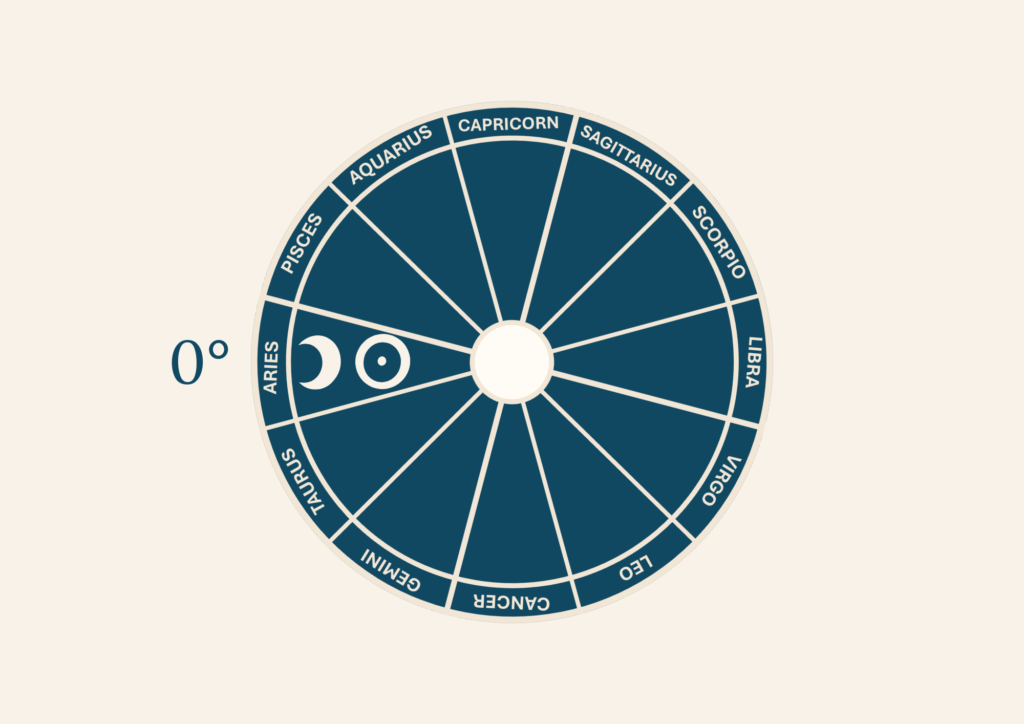
Conjunction (0°)
Sign-Based: Same Polarity, Modality, Element
Degree-Based: 0°
Conjunctions aren’t originally considered an aspect, they show a merging of two planets rather than a relationship between them. Some planets combine better than others depending on their nature. Because of this the conjunction can range from harmonious to conflicting. Generally, the conjunction shows that two planets must work with the same qualities to achieve their goals even if the inherent missions of the planets might be conflicting.
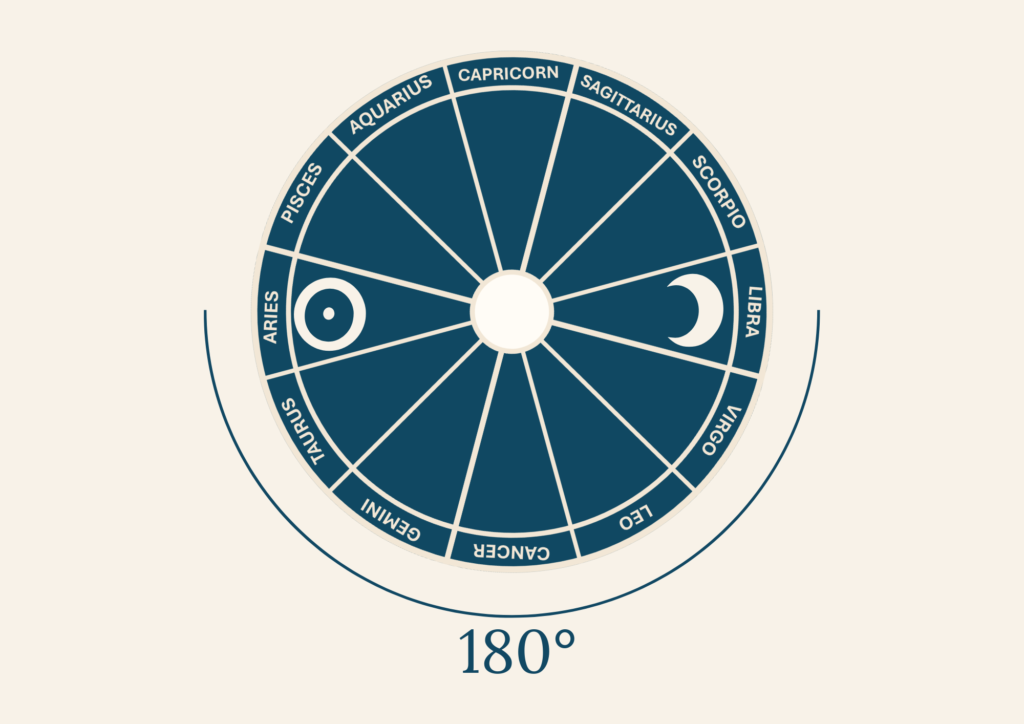
Opposition (180°)
Sign-Based: Same Polarity, Same Modality, Different Element
Degree-Based: 180°
Oppositions happen when two planets are placed at opposite ends of the zodiac. The two planets involved must achieve their individual goals through opposite means. This can cause friction but it can also be complementary, because combined two opposites make up a bigger whole and tend to balance each other out.
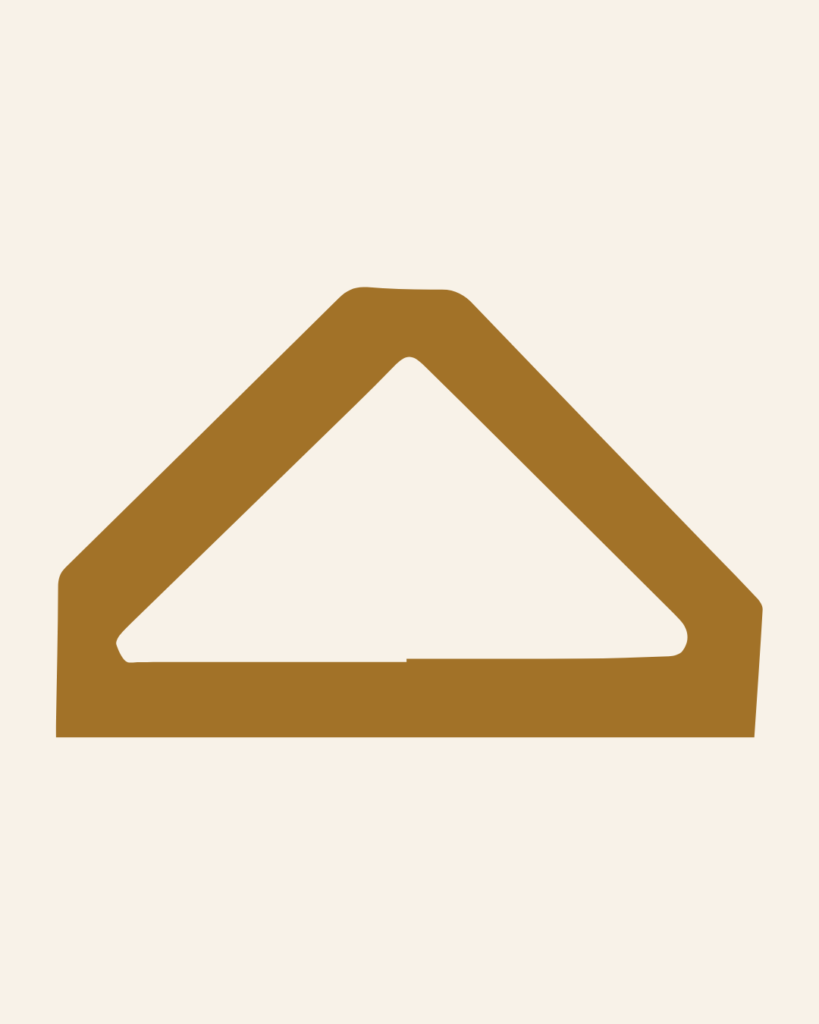
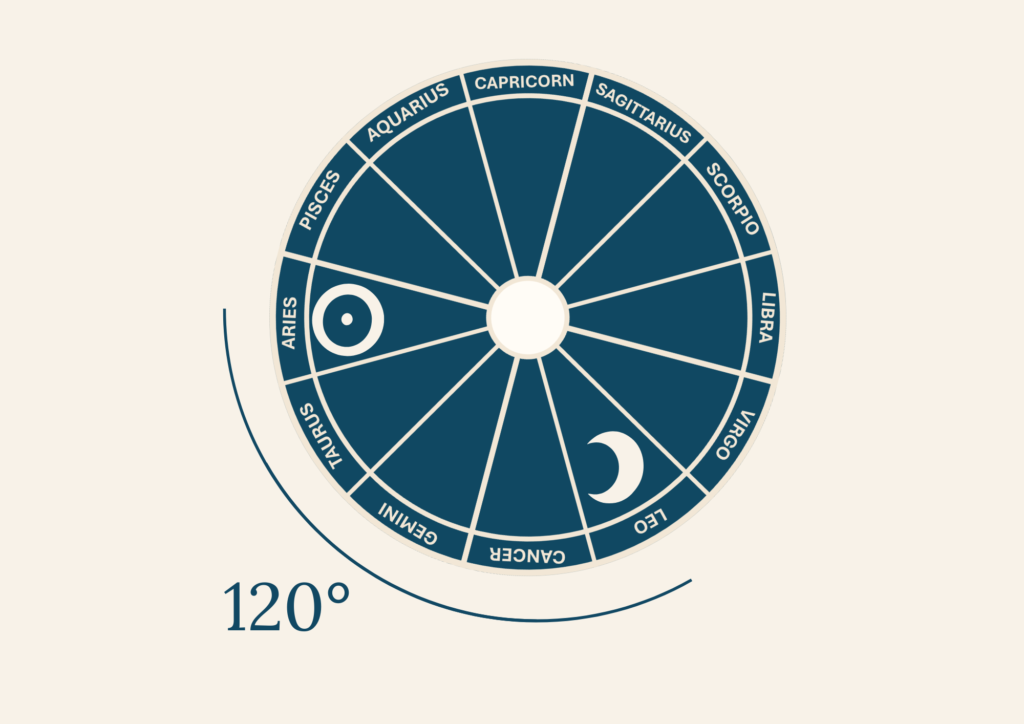
Trine (120°)
Sign-Based: Same Polarity, Same Element, Different Modality
Degree-Based: 120°
Trines happen between signs with the same element, they are the most harmonious aspect. Here, two planets try to achieve their natural missions through the same overarching goal. Because of this, they can support each other in their objectives like two people with matching skillsets on the same group project. Because there is no friction, the trine effect sometimes goes unnoticed, it just comes so natural to us that we take it for granted.
Square (90°)
Sign-Based: Same Modality, Different Polarity, Different Element
Degree-Based: 90°
Squares happen between signs with the same modality. Here the planets try to achieve different goals with similar means, like two people with similar skillsets working on different projects. Not only that, the projects are competing with each other and only one group can win. Naturally, these people aren’t going to help each out very much or, even worse are going to sabotage each other. Because of this the square requires some decision between one planet or another, and this always creates tension.
Sextile (60°)
Sign-Based: Same Polarity, Different Modality, Different Element
Degree-Based: 60°
Sextiles happen between two signs with complementary elements. The little sister of the trine, the sextile is a harmonious aspect. Here, two planets work not toward the same overarching goal, but toward two goals that are supportive of each other. This is like two friends on different but overlapping projects. Naturally, these friends have matching skillsets and like to help each other out. The sextile doesn’t happen with the same ease as the trine and requires some extra effort, but it will likely pay off for both people involved.
These are just the basics, there is more nuance when considering aspects, such as the explanation for why the aspects work the way they do based on the arrangment of the zodiac signs or the meaning of the out-of-sign aspects based on the division of the 360° zodiac circle.