Degree-Based Aspects
Degree-based aspects show the relationship between two planets based on the divsion of the 360° zodiac circle. While each aspect has a distance at which the aspect becomes exact, orbs allow for a field of influence. Has a planet reached this orb, the aspect comes into effect. There is no fixed answer on how big the orb should be. Some astrologers base their orbs on the planets involved, some base their orbs on the aspect involved. While I can’t give you an exact number, here are two things worth keeping in mind.
The exact aspect is the most potent. Here, the influence is felt the most. The farther the planets move away from the exact aspect, the more the influence decreases, until it isn’t felt anymore. These are the transitioning spaces between two aspects. But again, there is no fixed answer for where one space starts and the other ends and it is possible that some are more attuned to notice the more subtle influences.
Because of this field of infleunce a degree-based aspect can be ineffect even when the sign-based aspect isn’t. This is called an out-of-sign aspect. If the sign-based aspect doesn’t match the degree-based aspect the infleunces are altered. Aries and Virgo do not share a sign-based aspect, they don’t have anything in common based on the arrangement of the zodiac, but a out-of-sign trine between a planet at 29° Aries and one at 1° Virgo can create for an unexpected cooperation between the planets and a way to combine the energies of these two signs in useful ways despite their natural differences. Keeping an eye on such discrepancies can give some more insigh and should not be overlooked.
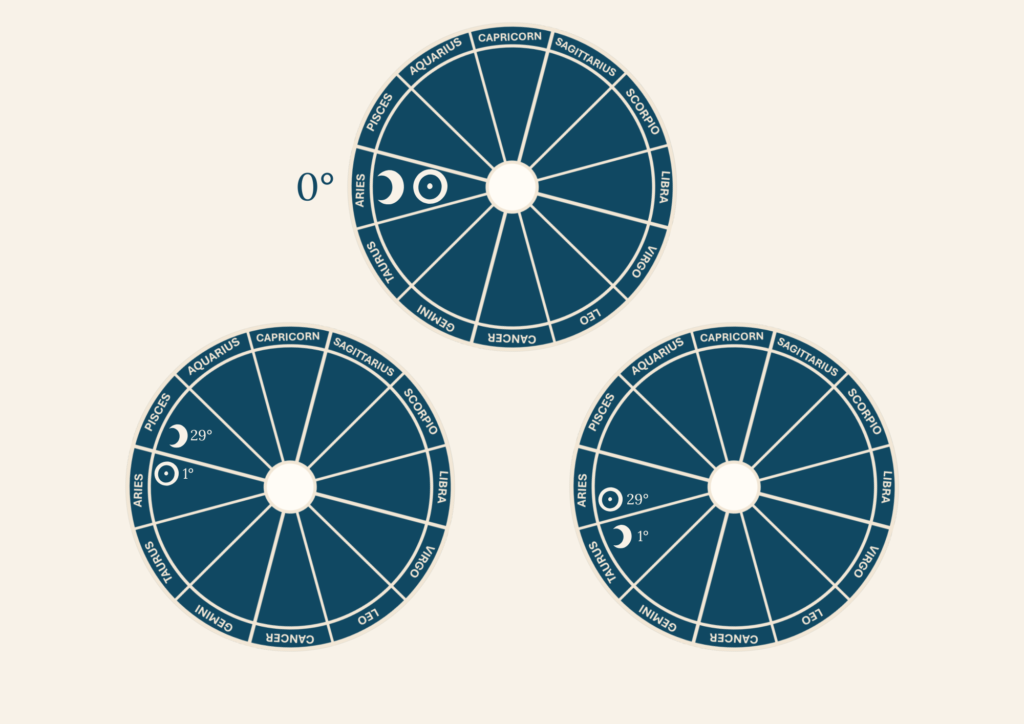
A degree-based conjunction happens when two planets occupy the same degree. When the conjunction is exact the two planets are 0° apart from each other, which highlights the unity symbolized by this aspect.
Sign-based conjunctions happen within the same sign, both planets must work with the exact same qualities. Out-of-sign conjunctions are more difficult to utilize, because signs adjacent to each other are in a sign-based aversion and do not share any qualities; their polarities, elements, and modalities are different.
In this case the conjunction is complicated because it must unify two qualities that do not naturally match. The out-of-sign conjunction says that two people that have nothing in common must work together on a project simply because they sit next to each other.
The zodiac is arranged so that each sign improves in some way upon its preceeding sign. Because of this an out-of-sign conjunction might feel like a tug of war between two people insisting on their way of doing things. To the preceeding sign the ways of the subsequent sign will seem like they exceed the preceeding sign’s abilities, while to the subsequent sign the ways of the preceeding sign will seem out of date.

Conjunction (0°)
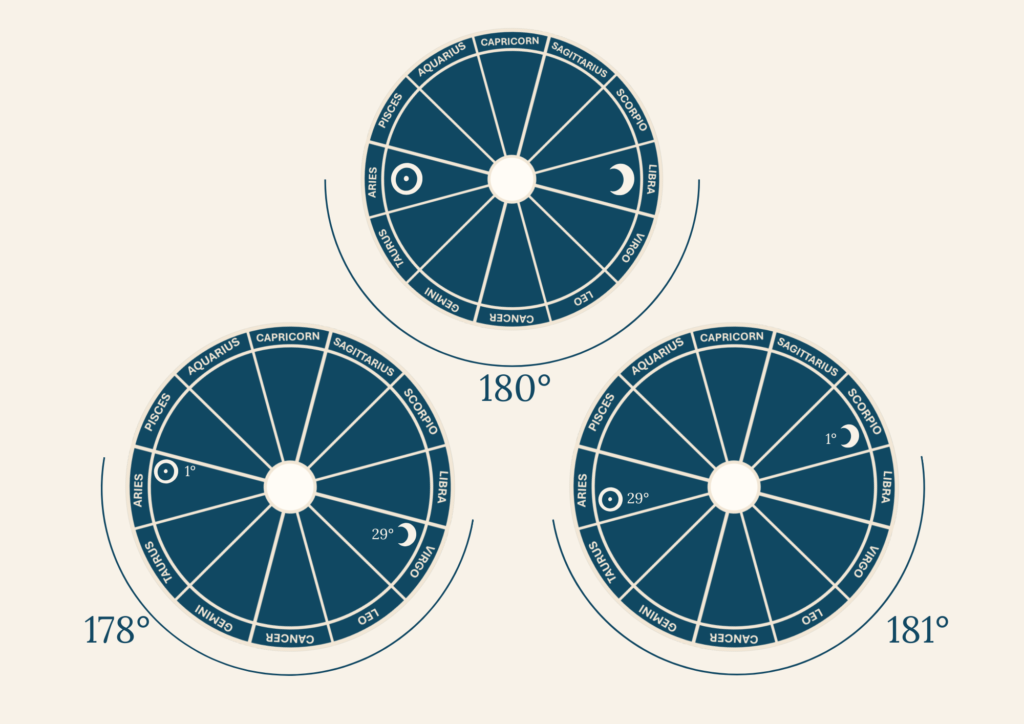
A degree-based opposition happens when two planets are 180° apart from each other, which usually places them in opposing signs with complementary qualities. This can cause friction but also gives oppor-tunity for completion, like putting two halves together.
Out-of-sign conjunctions are even more complicated, because they slip into signs that are in a sign-based aversion and do not share any qualities; their polarities, elements, and modalities are different.
A sign-based opposition is like putting together two halves of something that naturally makes up a cohesive whole, whereas the out-of-sign opposition is like smacking togehter two halves of two different things trying to make it into something complete even though it never naturally belonged together. This heightens the friction of the opposition and make the process of combining their engeries really difficult. It’s as if one pieces is either too big or too small to fit the other.

Opposition (180°)
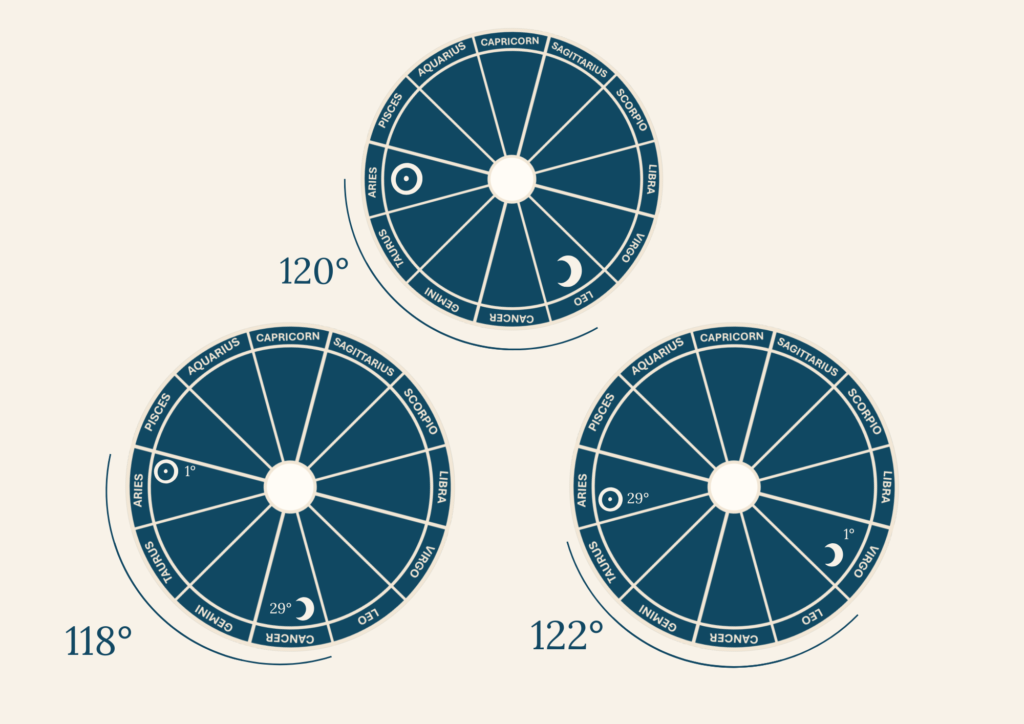
A degree-based trine happens when two planets are 120° apart from each other, which usually places them in signs of the same element. The overall focus of these signs is the same while the manner in which the signs of a trine try to achieve their goal is supplementary to each other.
Out-of-sign trines are more difficult than a regular trine because they either slip into a sign-based aversion, where the signs involved share no qualities with each other, or into a sign-based square, where the signs are at odds with each other because their focus is different.
A trine in a sign-based aversion may feel like two people with completely different qualities and goals being forced on working together. The degree-based trine says ease and harmony ca be achieved between two energies or qualities that do not naturally have anytihng in common.
A trine in a sign-based square may feel similar. Usually, the differnce in focus would cause friction and a need to make a decision between the two, but the degree-based trine says that they can be combined in a creative way.
Trine (120°)
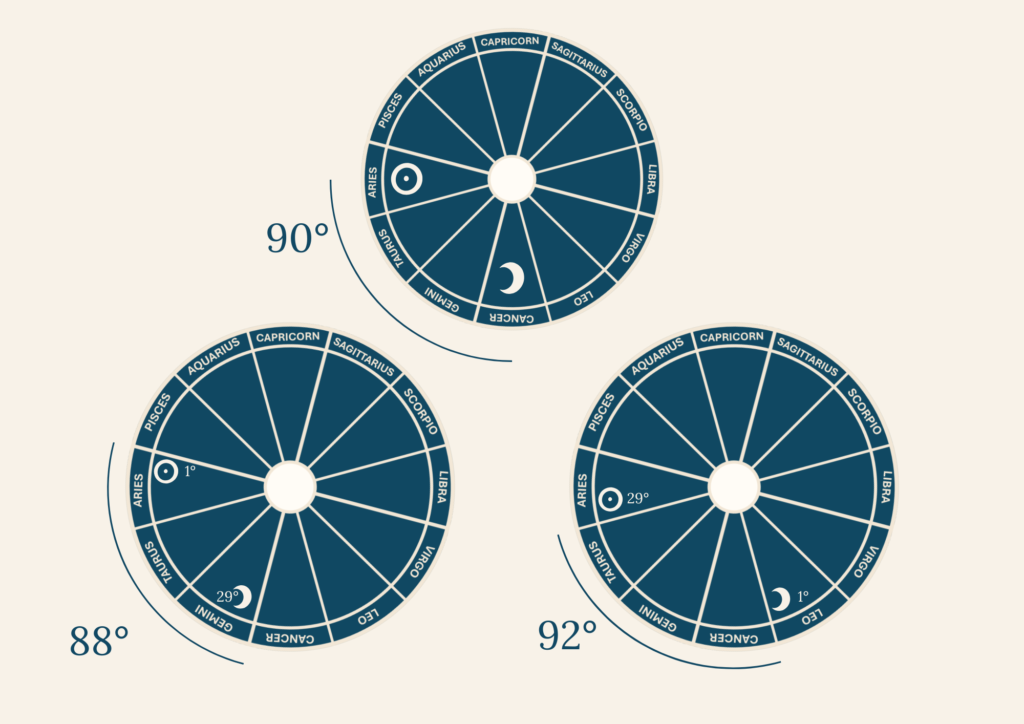
A degree-based square happens when two planets are 90° apart from each other, which usually places them in signs of the same modality. The manner of acting is the same, while the speed, general direction as well as the focus is different. The square naturally shows a tension between two different goals.
Out-of-sign squares are easier than a regular square because they either slip into a sign-based trine, where the signs focus is the same, or into a sign-based sextile, where the foci of both signs are not exactly the same but supportive of each other. This doesn’t mean that all difficulties are out of the way, because the square still demands friction.
A square in a sign-based trine may feel like two people that naturally have the same goal still being at odds with each other. Why? Well, at least from a sign-based persepctive there is no reason for it, but the degree-based square still calls for conflict.
A square in a sign-based sextile may feel quite similar except that the two people’s goal is not the same but complementary. Still there is some disagreement and conflict mixed into the whole ordeal, because the degree-based square gives a feeling of something being at odds.

Square (90°)
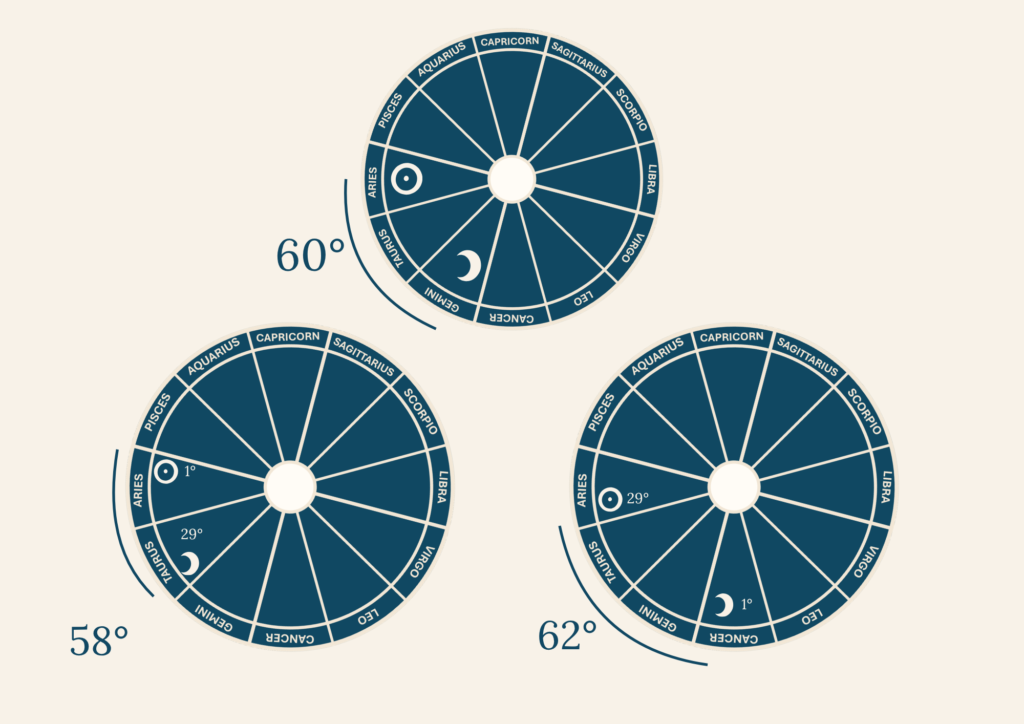
A degree-based sextile happens when two planets are 60° apart from each other, which usually places them in signs with complementary ele-ments. The overall speed and direction is the same, the foci of both signs are supportive of another, and the manners of action are supportive as well. Because of this the sextile shows the possibility of collaboration.
Out-of-sign sextiles are a bit more difficult than regular sextiles, because they either slip into a sign-based aversion, where adjacend signs do not have anything in common, or into a sign-based square, where the foci of both signs are in tension with each other.
A sextile in sign-based aversion may feel like two people with different qualities and goals being forced to collaborate because their foci match, they are not the same, but they can work together. The degree-based sextile says that collaboration can improve both projects, but finding the way in which they match might be a little harder when the sign involved are in aversion to another.
A sextile in a sign-based square may feel like two people, whose goals do not match or are at odds with each other, having to collaborate and find a way to make it work. The degree-based sextile says that collaboration can ease any friction, but it will be harder when the signs involved are naturally in square to each other.

Sextile (60°)