
The Twelve Houses - Arrangment
The twelve houses are the WHERE of the astrolocial language. They show the areas of life in which the topics of the planets are unfolding. They aren’t necessarily a physical place (although they can be), but the metaphorical spaces in which something is happening.
There are multiple ways in which the houses and signs can be combined in a natal chart. The simplest version is called the whole sign house system in which one house is equated with one sign.
A house can be vistited by no planet at all, then it is called empty, but it can also be occupied by one or multiple planets. An empty house doesn’t mean that there is nothing happening, but the more planets there are in one house, the more emphasis is put on its life area.
As with the planets and signs there is a specific arrangment to the houses that makes it more easy to memorize them and helps explain their different meanings.
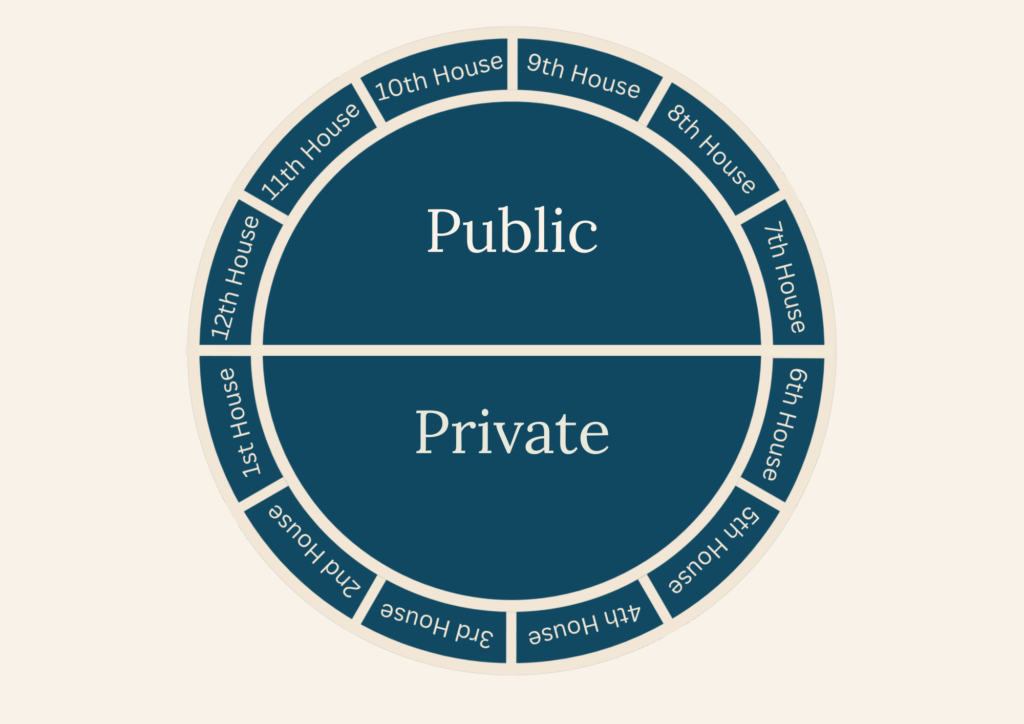
Public & Private
If you divide the chart horizontally, it is split into a public and a private section, where houses 1 to 6 are considered private and houses 7 to 12 are considered public.
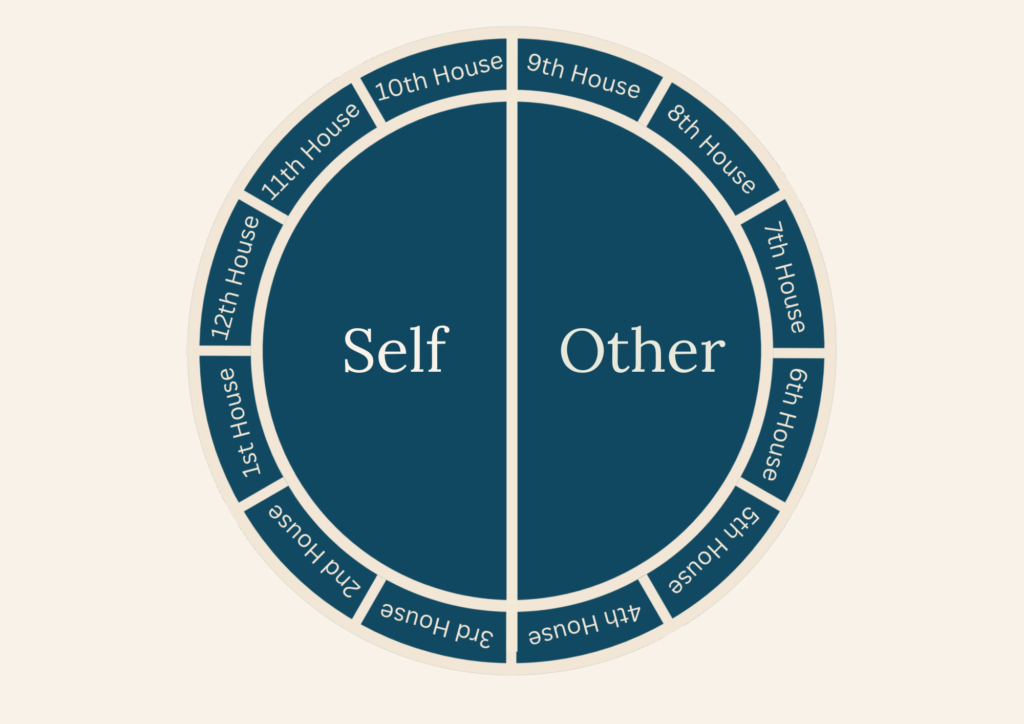
Self & Other
If you divide the chart vertically, it is split into a section focused on yourself, houses 10 to 3, and a section focused on the other, houses 4 to 9.
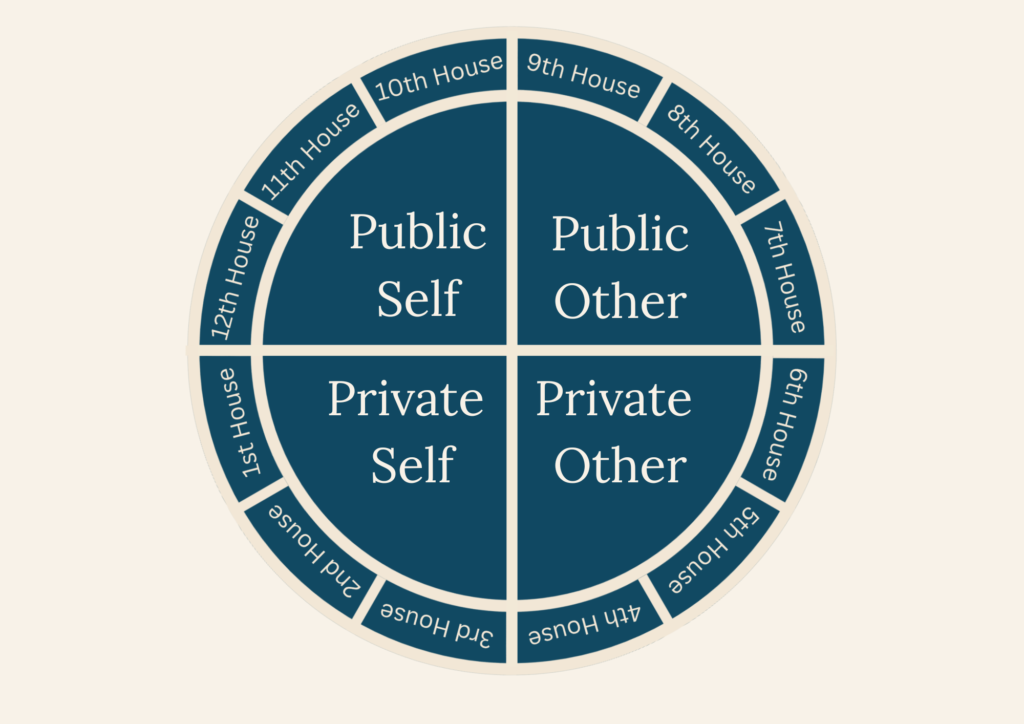
Four Quadrants
Taking both of these divisions into account, the chart is split into four quadrants, which creates one section focused on ones personal development in the private (1-3), one section where one interacts with others in private spaces (4-6), one section where one interacts with others in public spaces (7-9) and one section where one is focused on ones personal belonging to the public (10-12).
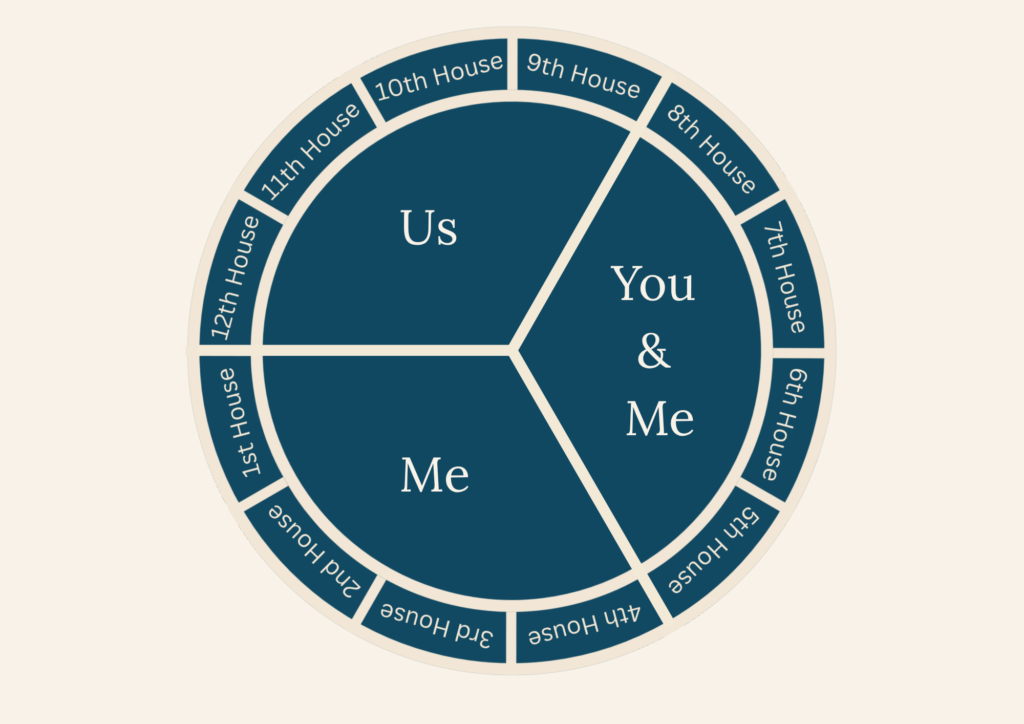
Me, Me and You & Us
Alternatively, the houses can be split into three groups of four, in which houses 1 to 4 have to do just with “Me”, that being you as one single person, while houses 5 to 8 have to to with “Me and You” as in how you interacting with someone else while both of you are separate, and houses 9 to 12 have to do with you being merged into the greater unity of “Us”.
Angularity
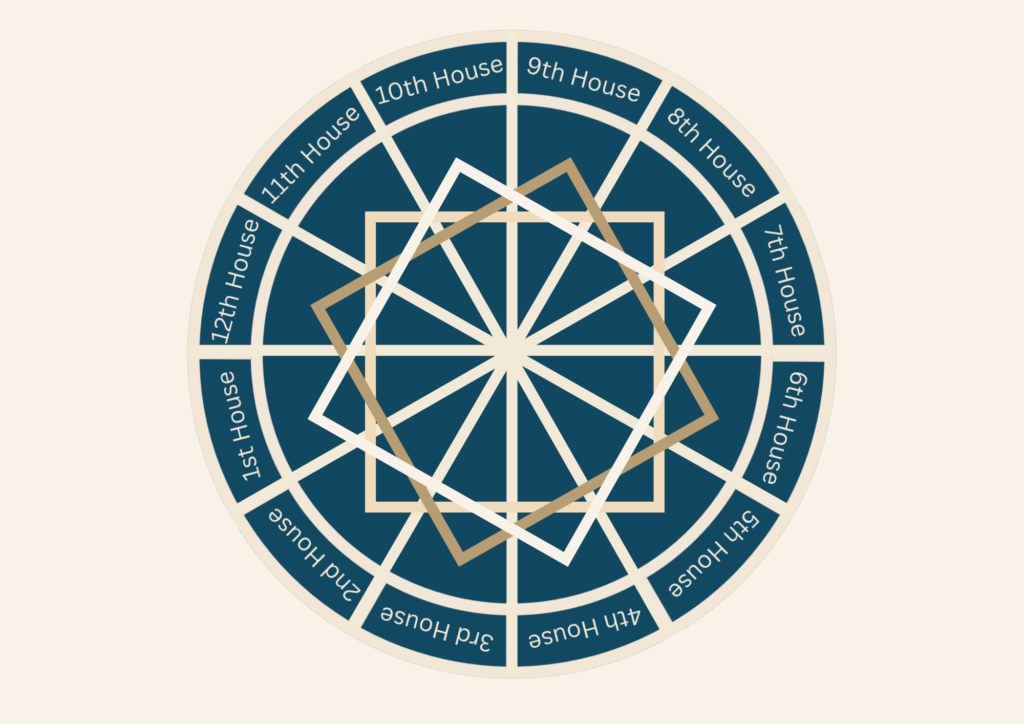
Angularity divides the twelve houses into three types depending on their strength and energy. In counterclockwise motion, a cadent house is followed by an angular house which is followed by a succedent house.
Cadent Houses – 3rd, 6th, 9th, 12th
Angular Houses – 1st, 4th, 7th, 10th
Succedent Hosues – 2nd, 5th, 8th, 11th
Cadent houses are the weakest with low energy, succedent ones are of moderate strength, and angular houses are the most powerful and energetic. The angular houses are considered the peak where the bulk of the action is taking place. The succedent house shows the carrying forward of the angular house’s action and gives additional support, while the cadent house shows what comes before the action and offers the possibility of rest or mental preparation.
Area of Focus
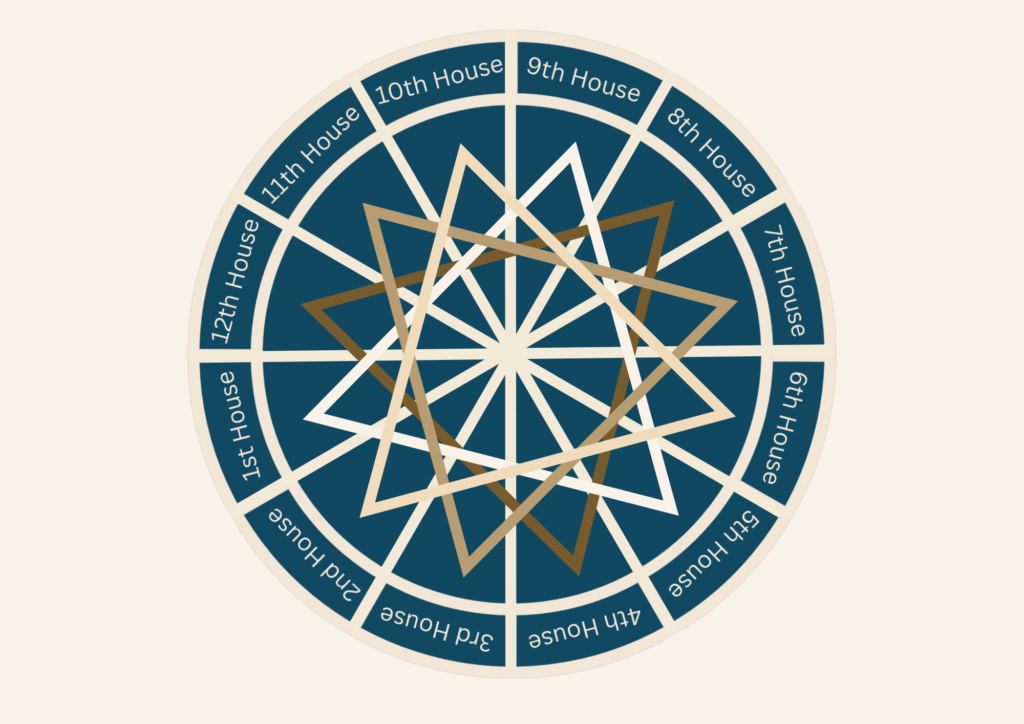
The houses can be grouped into four areas of focus with three houses each.
Houses of Self – 1st, 5th, 9th
Houses of Work – 2nd, 6th, 10th
Houses of Relationships – 3rd, 7th, 11th
Houses of Belonging – 4th, 8th, 12th
The houses of the self are connected to one’s personality for the first house, one’s self-expression for the 5th house and one’s belief system for the 9th house. They are the areas of life in which we engage with our own spiritual being.
The houses of work are connected to one’s way of making money for the 2nd house, one’s daily work and routine for the 6th house and one’s career and vocation for the 10th house. They are the areas of life in which we engage with the physical realm.
The houses of relationships are connected to one’s interaction with the people in our familiar environment for the 3rd house, one’s close relation-ships for the 7th house and one’s group-belonging for the 11th house. They are the areas of life in which we form intellectual ties with other people.
The houses of belonging are connected to one’s to one’s family and ancestry for the 4th house, one’s intimate emotional bonds for the 8th house and one’s metaphysical ties to the universe at large for th 12th house. They are areas of life in which we form emotional bonds to others. Additionally, these three houses are considered the houses of endings, because all of them are associated with letting go in some way.
Fortunate & Unfortunate Houses
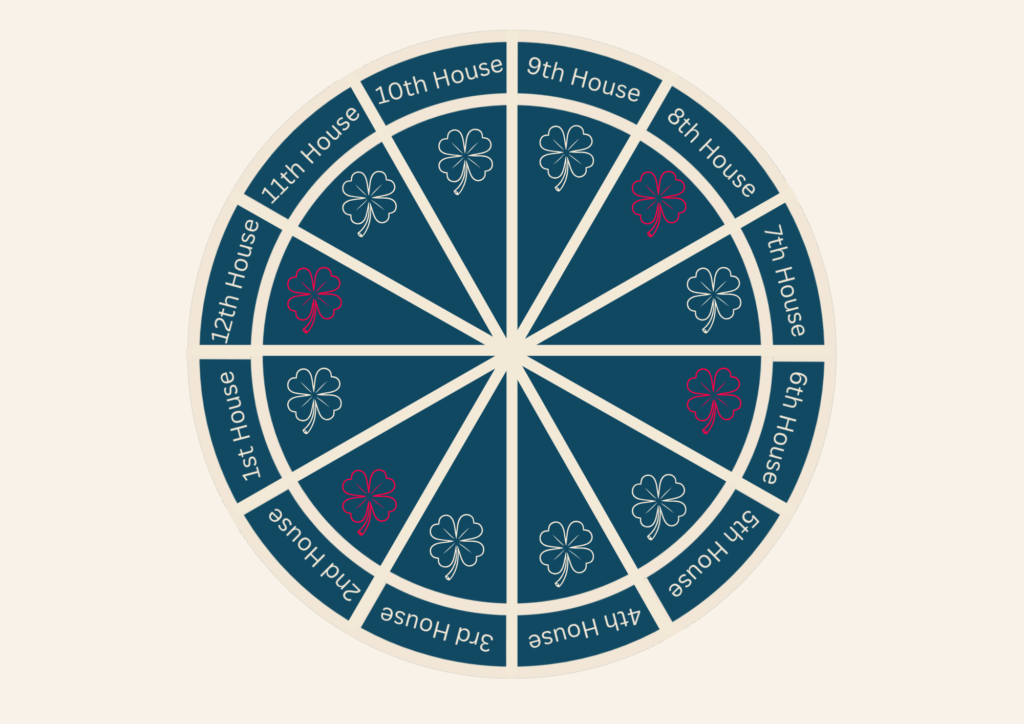
Depending on their topics houses can be divided into fortunate and unfortunate. For exmaple, the topics of carreer and public reputation (10th House) generally are considered positive while the topics of work and health (6th House) are often considered difficult.
Fortunate Houses – 1st, 3rd, 4th, 5th, 7th, 9th, 10th, 11th
Unfortunate Houses – 2nd, 6th, 8th, 12th
The 1st and 10th house are considered the most fortuante houses while the 6th and 12th are considered the worst unfortuante houses.
Similar to the benefic and malefic planets this is a generalization and the whole natal chart, the placement of the planets, can alter and mitigate this drastically.